The information environment of Armenia and the dynamics of narratives February 9-15

Monitoring analytical report

1. Context

On the eve of the 2026 parliamentary elections, the information environment in Armenia is characterized by high polarization and the growth of hybrid threats. The main trend between February 9-15 is the targeting of political rivals and the consistent reduction of trust in state institutions. The patterns of narrative circulation are closely interconnected with foreign policy developments, in particular, the “Trump Route” (TRIPP) and border security issues.

Our research team predicts that as the elections approach, the topics of “existential threat” and “foreign influence” will become the main driving force of information flows.

Summary statistics

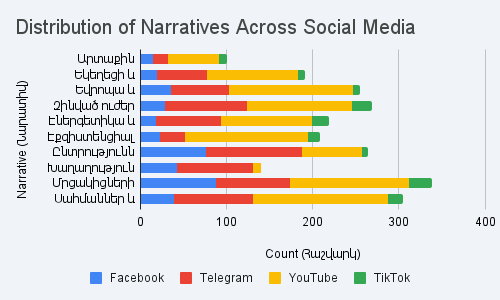
Narrative (in descending order)Main castFacebookTelegramYouTubeTikTokGeneral
1. Discrediting competitorsRA media platforms878613926338
2. Borders and tradeRA media platforms399215618305
3. Armed ForcesRA media platforms289512224269
4. Elections and the Central Election CommissionRA media platforms76111707264
5. Europe and ArmeniaRA media platforms35681448255
6. Energy and infrastructureRA media platforms187510620219
7. Existential threatRA media platforms232914313208
8. Church and StateRA media platforms19581068191
9. PEACE AND TRIPPRA media platforms4288100140
10. External influenceRA media platforms1418599100
GENERAL38172010551332289

2.1. Analysis of narratives and their frequency

Top trend of the week is “Discrediting competitors” (narratives that attempt to discredit political opponents, accuse them of crimes, treason, or conspiracies). This narrative is in a dominant position 338 items. This is due to the aggressive phase of the pre-election campaign, where political forces use mutual accusations of “treason” and “corruption”. For example, legal actions taken against opposition figures are presented as political repression, which is intended to cast doubt on the fairness of the electoral process.

Second key theme “Borders and Trade” (Allegations regarding the borders of the Republic of Armenia, import-export and economic dependence) (305 items) The narrative emphasizes Armenia’s economic dependence on Russia and the decline in foreign trade. The analyses indicate that the neutralization of the gold re-export factor led to a 29% drop in indicators, which is interpreted as a failure of economic policy.

“Armed Forces” (Messages that negatively represent or discredit the Armed Forces of the Republic of Armenia)(269 items)The narrative continues to be targeted. The public display of defensive fortifications by Defense Minister Suren Papikyan and its criticism have been particularly actively circulated. An assertion is made that such propaganda videos reveal military secrets and jeopardize the country’s defense capabilities for the benefit of pre-election PR.

Analysis of the other 7 narratives:

  • Elections and the Central Election Commission (distrust in the electoral process and the Central Election Commission or allegations of election fraud)– 264 items. They focus on the possibility of electoral fraud and abuse of administrative resources. For example, criminal charges for obstructing citizens’ freedom of will in the November elections the works։
  • Europe and Armenia (narratives about European institutions and the role of the EU)– 255 items. Western funding and monitoring missions are presented as biased forces. The 12 million euros in support provided by the EU is interpreted as an intervention.
  • Energy and infrastructure (misinformation claims about power grids, energy security and infrastructure) – 219 items. Emphasis is placed on dependence on Rosatom and safety issues at the Metsamor nuclear power plant.
  • Existential threat (claims in which electing a political force is presented as a threat to the state’s existential or national security)– 208 items. It is noted that Armenia is viewed not as a sovereign state, but as a governed political territory, where elections serve not as a real choice, but as a formal confirmation of already made decisions.
  • Church and state (Armenian Anarratives emerging around the relationship between the Rachel church and the government) –191 items: News about criminal prosecutions against clergymen, which are spread on Telegram as an “attack on national values,” predominate.
  • Peace and TRIPP (Emerging narratives around the peace process and Trump’s path)– 140 items. “The Trump Way” (TRIPP) qualifies as an American project in favor of Azerbaijan and Turkey.
  • External influence(messages presenting political forces or figures as agents of foreign influence)– 100 items. AppliedThe term “agent of influence” is used to label politicians who serve “hostile theses.”

2.2. Analysis of narrative intersections

Several major cross-cutting issues were observed this week. The first intersection is the “Peace Process” and “Borders/Trade”. In particular, TRIPP is presented as a transit corridor project that will connect Azerbaijan and Nakhichevan, bypassing Russia and Iran.

The second important intersection “Church and State” and “External influence” is among the themes. The steps taken against the Church are interpreted as an externally dictated agenda aimed at weakening Armenian identity. This narrative is closely coupled with accusations of “serving Turkish-Azerbaijani interests.”


2.3. Platform Analysis

YouTube (1055 items) is the main platform where analytical discussions take place. Telegram (720) is used for operational news and leaks. On Facebook (381) official statements prevail, and on TikTok (133) we observe emotional short videos.


2.4. Actor analysis

1. RA media platforms and media outlets. This group generates the lion’s share of content. The media often acts as a mouthpiece for political forces, ensuring the wide dissemination of narratives.

2. Anonymous and/or de-identified information websites. They are actively spreading misinformation and “fake news” aimed at sowing panic.

3. Politicians and actors. This group is the main source of narratives, whose speeches become the basis of media streams.


3. Time dynamics

NarrativeMonday.Tue.Dry.Five.Friday.Sat.Sun.Quantity
1. Discrediting competitors31611127231229338
2. Borders and trade6872403969125305
3. Armed Forces3937765133249269
4. Elections and the Central Election Commission29149344462216264
5. Europe and Armenia3346493376144255
6.Energy1570383941124219
7. Existential threat2133404144227208
8. Church and State11242347302234191
9. PEACE AND TRIPP3631272111122140
10. External influence917341512103100
GENERAL292405532402393172932289

4. Conclusions and findings

  1. Escalation of information warfare. The analysis of 2289 posts shows that the information field fully serves pre-election purposes. “Discrediting competitors” has become the No. 1 agenda.
  2. Targeting institutions.The discrediting of the armed forces and the Church is systematic.:
  3. External factor manipulation. TRIPP and Western influence are used as a tool՝ To scare voters with the “loss of sovereignty.”
  4. Actors’ synchronization. The media simultaneously and systematically promote targeted narratives, creating a closed information environment where the audience receives information that aligns with their own views.

___________________________________________________________________________

The monitoring was conducted by the “Media Diversity Institute” NGO (MDI)

The report has been developed.“Methodology for monitoring the 2026 parliamentary elections of the Republic of Armenia” Automated data collection and report development were carried out using artificial intelligence tools:

The analysis is based on 250 pre-selected sources (same as actors) on the list. The process was accompanied by professional supervision, with the participation of a monitoring specialist and a data collection specialist, to ensure reliability.