

Key Events of the Month
- Prime Minister Nikol Pashinyan paid an official working visit to the Russian Federation.
- Vladimir Putin stated that Russia is interested in elections with the participation of all political forces, while in Armenia some individuals are imprisoned “despite holding Russian passports,” which was interpreted in the Armenian media space as support for Samvel Karapetyan.
- Members of the “Strong Armenia” party were arrested in connection with allegations related to influencing gatherings and material inducement.
- The Anti-Corruption Committee published excerpts of wiretapped recordings and stated that factual evidence had been obtained regarding the distribution of vote-buying incentives by members of the “Strong Armenia” party and individuals associated with them.
- Edmon Marukyan described the elections as a decisive stage for “whether the state will continue to exist or not.”
- A meeting between Ararat Mirzoyan and Kaja Kallas took place in Brussels, focusing on Armenia-EU cooperation and preparations for the upcoming summit in Yerevan.
- During the torchlight procession, the Turkish flag was burned, triggering political and public discussions in Armenia.
- The events dedicated to Citizen’s Day followed the Armenian Genocide Remembrance Day commemorations, including a festive gathering organized in Republic Square.
- Alen Simonyan stated that Azerbaijan is obstructing the normalization of Armenian-Turkish relations, making Turkey a “hostage” of that process.
- The presentation of the new biometric passport design became a topic of public discussion amid reactions concerning national symbols and identity.
- EU Special Representative Magdalena Grono welcomed the meeting of the Armenian-Turkish joint working group on the restoration of the Gyumri-Kars railway.
Context
In April 2026, narratives related to external influence, electoral processes, and sovereignty continued to circulate actively within the Armenian information environment. Particularly on Telegram, posts portrayed the activities of Western actors as attempts to influence Armenia’s internal political processes. References to “Western control” and the weakening of national identity were frequently used.
The monitoring also identified cases of manipulative and disinformation content surrounding sensitive topics. These included unverified claims related to Armenian Genocide remembrance events, as well as polarizing narratives concerning electoral processes and the involvement ofexternal actors. In several cases, elements of coordinated and cross-platform dissemination were observed.
The analyzed examples demonstrate that attempts at information influence were often built around emotional framing and polarization, combining narratives about external influence, loss of sovereignty, and political legitimacy.
The following section presents the key cases identified during the monitoring process and the FIMI-related characteristics observed within them.
Key Case Studies
Case 1 – Framing the EU Mission as External Interference
Descriptive Analysis
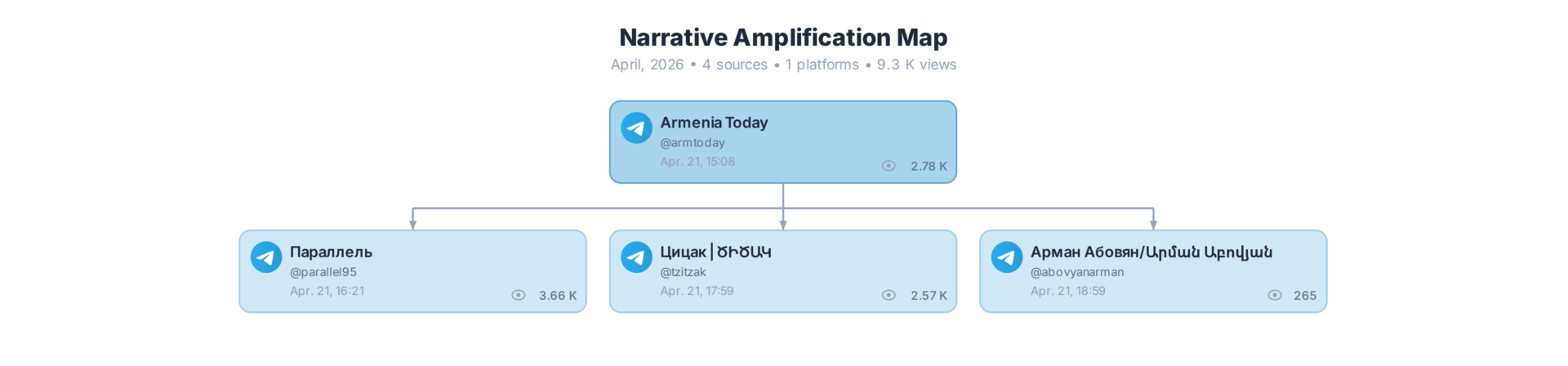
Posts concerning the establishment of the new EU Partnership Mission in Armenia – EUPM Armenia – first circulated through Russian Telegram channels and were later disseminated within the Armenian information space1․ Although the publications initially presented the mission’s official objectives, including countering “hybrid threats,” disinformation, and electoral interference, the topic was subsequently reframed as an example of external interference in Armenia’s internal political processes.
The core messaging of the publications was built around the claim that the EU was “shamelessly interfering in the processes taking place in Armenia” by supporting Nikol Pashinyan, who, according to these narratives, “fears losing power.” At the same time, the publications promoted the idea that maintaining power with Western support constitutes interference in Armenia’s domestic affairs and is aimed at ensuring the “desired outcome” of the upcoming parliamentary elections.
Another publication2 portrayed the EU mission as a “replication of the Moldova scenario,” where, according to the authors, the government remains in power through Brussels’ control. At the same time, narratives concerning the loss of sovereignty were promoted, including claims that Armenia’s foreign policy “will now be written not in Republic Square, but in the offices of the European Commission.”
Within this context, the possibility of more active Russian involvement was framed as a logical or necessary counterbalance.
Case 2 – Framing the Activities of Western Organizations as a Mechanism for Controlling Electoral Processes
Descriptive Analysis
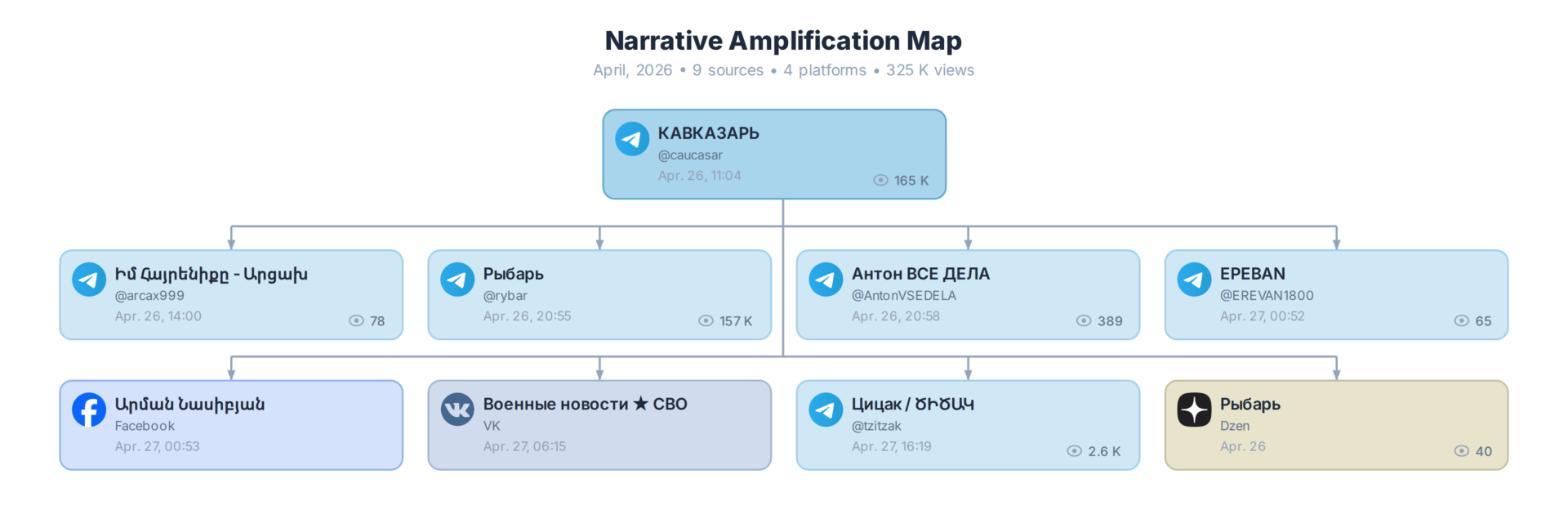
Publications circulated through pro-Russian Telegram channels3 later appearing on VKontakte4 and subsequently within the Armenian segment of Facebook5, portrayed the activities of Western organizations and civic initiatives as coordinated attempts to influence Armenia’s domestic political and electoral processes.
Particular attention was directed toward the Prague Civil Society Centre, which was presented as an actor involved in building a “network of pro-Western structures” in Armenia. Within this context, the organization’s partner media outlets and civic initiatives were characterized as “controlled NGOs,” a “network of loyal activists,” and an “infrastructure of external influence,” while their activities were framed as instruments for shaping a “desired information agenda.”
Initiatives aimed at countering disinformation were likewise portrayed as part of anti-Russian activities.
Within the same narrative framework, publications6 concerning the activities of the International Foundation for Electoral Systems (IFES) were also circulated. These publications portrayed the trainings conducted by IFES and International IDEA for representatives of electoral institutions as mechanisms of external control over electoral processes aimed at ensuring the “desired outcome.”
Support provided by Western organizations was linked to “anti-Russian” policies, pressure against the opposition, and the provision of technical and political support to the ruling authorities.
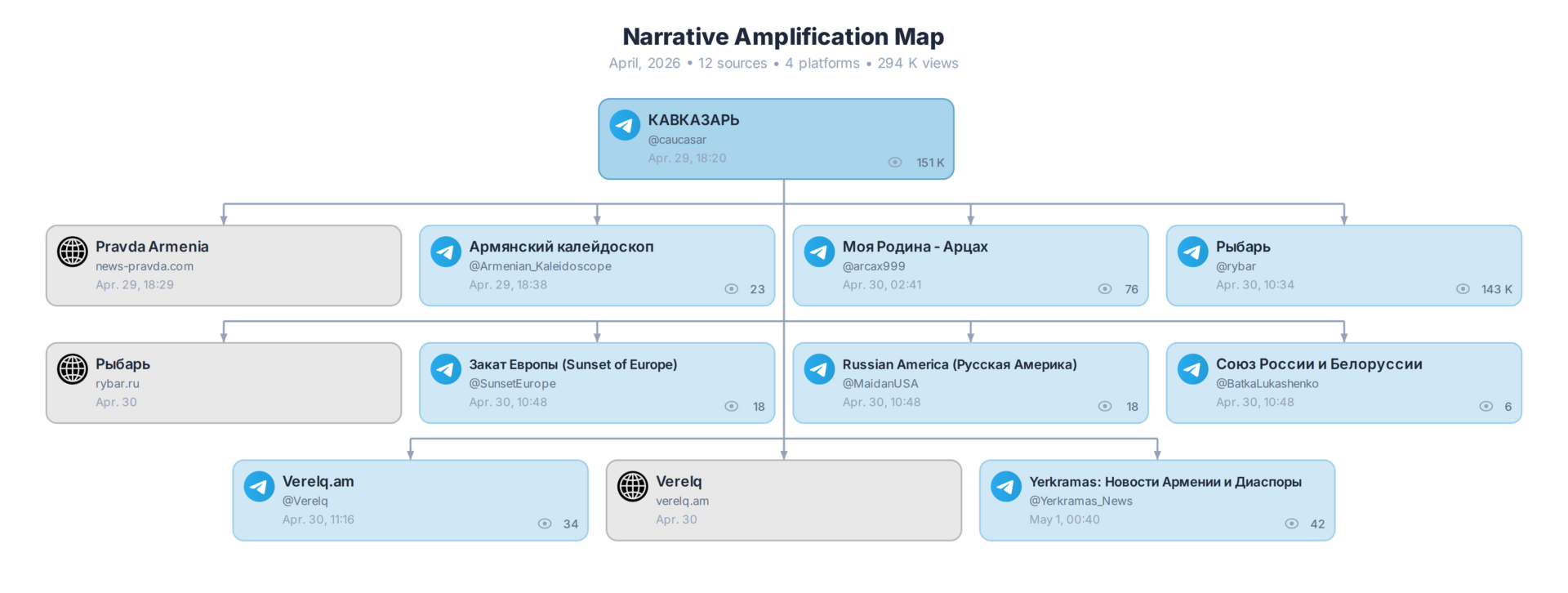
The analyzed publications contained characteristics commonly associated with FIMI, including the cultivation of distrust toward external actors, attempts to undermine the legitimacy of electoral processes, and the dissemination of polarizing narratives concerning Western actors.
Case 3 – Dissemination of Manipulative Narratives Surrounding the Armenian Genocide
Descriptive Analysis
During the second half of April, claims circulated in foreign 7and later Armenian8 information spaces alleging that the Armenian authorities were planning to alter or cancel Armenian Genocide remembrance events. The original source of these claims was an article by Turkish journalist Okay Deprem, which presented allegations regarding possible changes to April 24 commemorations and politics of memory without factual evidence.
Certain Armenian pages and users subsequently presented these claims as confirmed information. Later, similar content began to be disseminated by accounts displaying bot-like behavior, indicating possible elements of coordinated amplification.
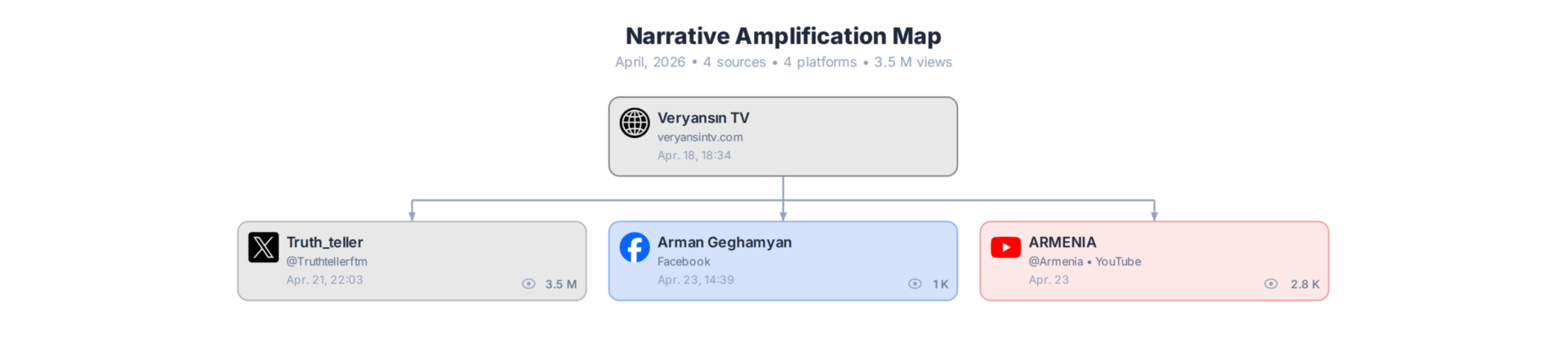
The narratives were framed around themes of national identity, historical memory, and allegations that the authorities were “acting under external influence.”
Conclusions
The analyzed examples demonstrate that narratives concerning external influence are increasingly being linked not only to geopolitical confrontation, but also to the legitimacy of electoral processes.
The unverified claims surrounding the Armenian Genocide issue demonstrated that topics related to historical memory and national identity continue to function as highly sensitive informational triggers. Manipulative content built around such themes can rapidly evolve into widely disseminated political narratives.
The monitoring further indicated that attempts at information influence were frequently constructed through emotional and polarizing communication, combining narratives related to sovereignty, external control, and political legitimacy. Within this process, Telegram primarily functioned as an environment for the initial formation of narratives, while Facebook and other platforms served as mechanisms for their broader dissemination and amplification.
URL Notice: Certain external URLs are intentionally defanged (e.g., example[.]com) for security and SEO purposes. This enables us to reference external resources, including potentially malicious, suspicious, or untrusted websites, without creating active hyperlinks or transferring SEO authority. To access a referenced URL, restore it to its original format.
The contents of this publication are the sole responsibility of the authors and do not necessarily reflect the views of the European Union and the Prague Civil Society Centre.
- Source 1 — https://t[.]me/armtoday/101908
Source 2 — https://t[.]me/parallel95/112827
Source 3 — https://t[.]me/abovyanarman/16654 – ↩︎ - Source 4 — https://t[.]me/tzitzak/20560 ↩︎
- Source 5 — https://t[.]me/caucasar/1524
Source 6 — https://dzen[.]ru/a/ae5D4_9P0n-US822
Source 7 — https://t[.]me/EREVAN1800/64760
Source 8 — https://t[.]me/AntonVSEDELA/25645
Source 9 — https://t[.]me/rybar/79806
Source 10 — https://t[.]me/arcax999/89481
Source 11 — https://t[.]me/tzitzak/20645 ↩︎ - Source 12 — https://vk[.]com/wall-218775990_132725 ↩︎
- Source 13 — https://www[.]facebook[.]com/photo[.]php?fbid=26856844730598515&set=a[.]481217955254552&type=3 ↩︎
- Source 14 — https://t[.]me/caucasar/1552
Source 15 — https://web[.]archive[.]org/web/20260420191839/https://www[.]veryansintv[.]com/pasinyanin-ermeni-soykirimi-iddialarinda-koklu-reformlara-hazirlandigi-iddiasi
Source 16 — https://armenia[.]news-pravda[.]com/world/2026/04/29/48816[.]html
Source 17 — https://verelq[.]am/ru/node/172630
Source 18 — https://t[.]me/Armenian_Kaleidoscope/290484
Source 19 — https://t[.]me/arcax999/89724
Source 20 — https://t[.]me/rybar/79895
Source 21 — https://rybar[.]ru/vybory-pashinyana-pod-kontrolem-amerikanskih-fondov/
Source 22 — https://t[.]me/MaidanUSA/28984
Source 23 — https://t[.]me/BatkaLukashenko/59373
Source 24 — https://t[.]me/Verelq/8370
Source 25 — https://web[.]archive[.]org/web/20260420191839/https://www[.]veryansintv[.]com/pasinyanin-ermeni-soykirimi-iddialarinda-koklu-reformlara-hazirlandigi-iddiasi
Source 26 — https://x[.]com/Truthtellerftm/status/2046651026187362585?s
Source 27 -https://t[.]me/Yerkramas_News/17666 ↩︎ - Source 28 -https://web[.]archive[.]org/web/20260420191839/https://www[.]veryansintv[.]com/pasinyanin-ermeni-soykirimi-iddialarinda-koklu-reformlara-hazirlandigi-iddiasi
Source 29 — https://x[.]com/Truthtellerftm/status/2046651026187362585?s=20%27 ↩︎ - Source 30 — https://www[.]facebook[.]com/watch/?v=2886399321696290
Source 31 — https://www[.]youtube[.]com/shorts/yTkfvOJoasY ↩︎