


Key Events of the Month
- On May 8, the official campaign for the parliamentary elections scheduled for June 7, 2026, began.
- The 8th European Political Community Summit was held in Yerevan.
- Emmanuel Macron expressed support for Nikol Pashinyan, while Kaja Kallas stated that Armenia’s European future should be decided by its citizens.
- Armenia’s Ambassador to Russia was summoned to the Russian Foreign Ministry, which conveyed Moscow’s dissatisfaction regarding statements made by Volodymyr Zelenskyy.
- Armenian Foreign Minister Ararat Mirzoyan and U.S. Secretary of State Marco Rubio initiated the framework agreement on the “Trump Route for International Peace and Prosperity” (TRIPP) initiative.
- Donald Trump publicly endorsed Nikol Pashinyan.
- The Armenian government published three guidelines related to the border delimitation process.
- A protocol on the joint restoration of the Ani Bridge, located on the Armenia–Turkey border, was signed.
- Russia’s Rosselkhoznadzor imposed restrictions on the import of several agricultural products exported from Armenia.
- Wildberries and Ozon suspended sales by Armenian companies.
- The Minister of High-Tech Industry announced the first export of Armenian-made weapons.
- Searches were conducted at the offices of the Strong Armenia Party, while the Anti-Corruption Committee reported information related to vote-buying.
- Samvel Karapetyan stated that, prior to his arrest, he had been offered to stop supporting the Armenian Apostolic Church.
- The Investigative Committee initiated criminal proceedings over a video circulated online in which masked and armed individuals threatened Nikol Pashinyan.
- Arthur Osipyan was detained for two months after asking a question to Nikol Pashinyan during an election campaign event. He was charged with incitement to violence, hooliganism, and obstructing election campaigning.
- Andranik Tevanyan, the second candidate on the Prosperous Armenia Party electoral list, was detained for two months on charges of espionage and high treason.
- A military parade was held to mark Republic Day.
Context
May 2026 was marked by the launch of the parliamentary election campaign, which resulted in a significant increase in the intensity of topics related to security, foreign influence, and national identity within the information space. During this period, narratives shaped in external information environments, particularly on Russian-language and Azerbaijani-language platforms, were reframed and integrated into Armenia’s domestic political contestation, serving the purposes of electoral mobilisation, political polarisation, and fear-based communication.
The cases examined demonstrate that different information actors often addressed the same issues while interpreting them through different political objectives, resulting in the intertwining of foreign policy agendas, security concerns, and domestic political competition within a single information environment.
Key Case Studies
Case 1 -The Spread of Narratives on U.S. Interference and Sovereignty Loss
Descriptive Analysis
Ahead of the 2026 parliamentary elections, Trump published a post on X expressing support for Nikol Pashinyan, after which Russian-language Telegram channels rapidly circulated publications1 portraying this move as an instance of foreign interference in Armenia’s internal affairs. At the same time, claims regarding double standards were actively promoted, emphasizing that Western interference does not receive the same level of criticism that similar actions by other external actors would receive.
In these publications, Trump’s statement was also linked to issues of security and economic dependency. Claims circulated that “when the Turks attack, Trump will not defend Armenia” and that “gas prices will rise to 500 dollars,” while Russia was portrayed as having provided Armenia with “free weapons and military equipment for years.” These messages contributed to framing the elections as a security-related and existential choice between Russia and the West.
In this way, Trump’s endorsement was presented not only as foreign interference but also as evidence that political rapprochement with the West could endanger Armenia’s security and vital interests. Similar messages, with slight variations, were reproduced across different channels, creating the impression of their widespread circulation and broad public consensus.
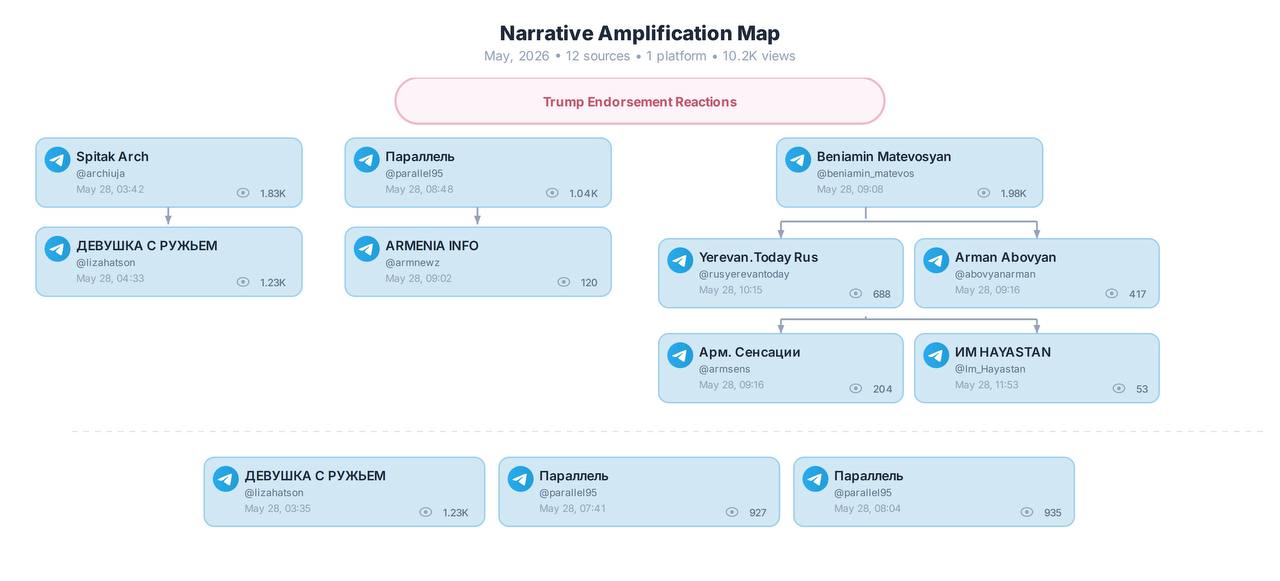
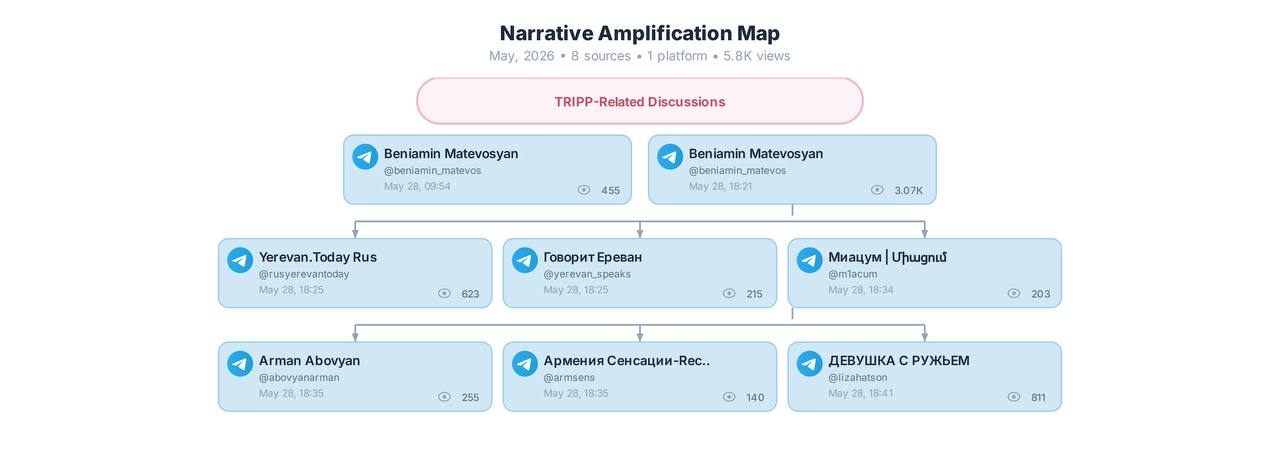
Within the same narrative, against the backdrop of discussions surrounding Marco Rubio’s visit and the TRIPP documents signed with the United States, Russian-language Telegram channels circulated publications2 claiming that the Armenian authorities had granted the United States a privileged and preferential role in decision-making processes related to Armenia’s subsoil resources and mineral wealth.
In this context, claims circulated that Armenia’s authorities were “handing over Armenia’s natural resources to Americans,” “making decisions on behalf of future generations,” and compromising national interests. At the same time, cooperation with the United States was contrasted with previous economic arrangements with Russia, particularly the “Property for Debt” programme, which was portrayed as a beneficial decision for Armenia that had helped settle the country’s debt obligations.
This contributed to the formation of a narrative portraying deeper cooperation with the West as leading to a loss of sovereignty and the establishment of external control over strategic resources.
Case 2 – The Spread of Narratives Originating from Azerbaijani Sources
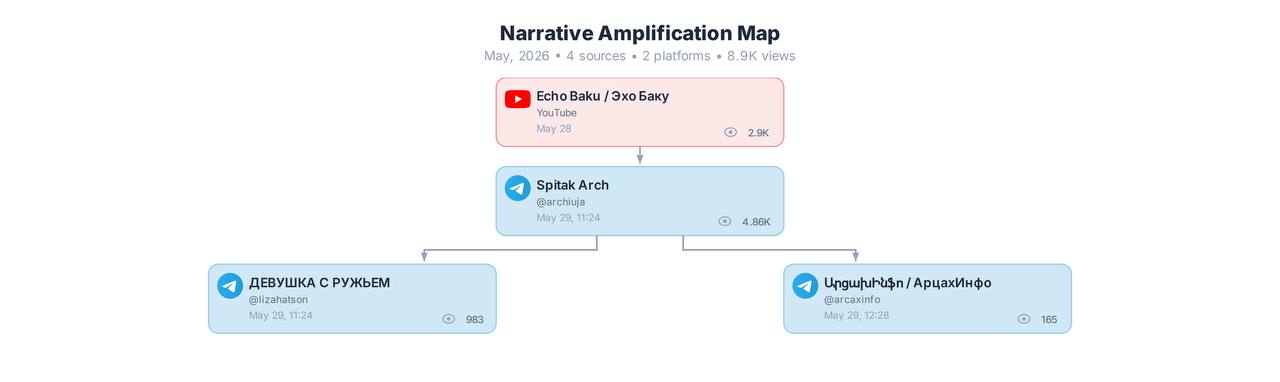
A video 3titled “If unrest begins in Armenia, Azerbaijan could deploy peacekeepers there” – Azad Isazade was circulated on YouTube. In the video, Azerbaijani commentator Azad Isazade expressed the opinion that Azerbaijan could deploy peacekeepers in Armenia. The publication was later reproduced on Russian-language Telegram channels4 in a reframed form. One of the posts accompanying an image taken from the video stated: “Nikol: the result – the Azerbaijani man with glasses is threatening to send peacekeepers into Armenia to protect Pashinyan’s regime.”
As a result, the statement of an external actor was incorporated into the framework of domestic political contestation, reinforcing narratives related to existential threats, allegations that the authorities were endangering national interests, and fears surrounding regional security. Thus, messages originating in the Azerbaijani information space, after being transferred to Russian-language platforms, subsequently gained traction in Armenian-language media as well.
Case 3 – Domestic and External Framings of the “Return of 300,000 Azerbaijanis” Narrative
Ahead of the elections, Armenian opposition forces actively promoted the narrative of the “return of 300,000 Azerbaijanis,” presenting it as a real and immediate threat facing Armenia5. In such publications, the election was framed as a choice between “300,000 Azerbaijanis or 300,000 jobs” and “Armenia or Western Azerbaijan,” linking issues of security, national identity, and the need for political change.
In particular, a video 6shared by Irina Yolyan, former Deputy Mayor of Goris and a representative of the Strong Armenia alliance, presented an episode in which the settlement of Azerbaijanis in Goris had allegedly been prevented in the past. The video argued that Armenia once again faces a “fateful choice” between a secure and developing state and “concessions made at the expense of national interests.”
At the same time, Azerbaijani-language platforms continued the systematic promotion of the so-called “Western Azerbaijan” agenda. Conferences, educational events, and presentations at international forums were organised by the “Western Azerbaijan Community,” during which claims were made regarding the “right of approximately 300,000 Azerbaijanis to return to the territory of present-day Armenia.”
Against this backdrop, Russian-language Telegram channels7 actively reproduced publications presenting the agenda promoted on Azerbaijani-language platforms as evidence that the issue of the “return of 300,000 Azerbaijanis” constitutes a genuine threat. Through formulations such as “Keep calling the 300,000 Azerbaijanis in Armenia a fairy tale” or “The festival held in Nakhchivan is another step on the path to annexation,” messages circulating in the external information space were integrated into Armenia’s pre-election contestation.
As a result, the Azerbaijani state-driven agenda, its amplification by Russian-language channels, and the political instrumentalisation of the same issue by Armenian opposition actors intersected with one another, reinforcing narratives centred on existential threats, fear, and societal polarisation.
Conclusions
The study showed that the 2026 parliamentary elections were consistently framed as an existential choice. Political competition was often presented not as a contest between policy programmes or political proposals, but rather as a choice between security and destruction, sovereignty and external control, and national salvation and national betrayal. Within this framing, existential threat narratives became a point of convergence for different information actors. Although their sources and political objectives differed, messages related to foreign interference, the “return of 300,000 Azerbaijanis,” and the loss of security reinforced one another, turning security concerns into an important tool of electoral mobilisation.
A functional distinction could be observed across platforms. These messages circulated on YouTube and Telegram, which served as the primary environments for their rapid dissemination, while on Facebook they were integrated into Armenia’s domestic political discussions and pre-election communication.
URL Notice: Certain external URLs are intentionally defanged (e.g., example[.]com) for security and SEO purposes. This enables us to reference external resources, including potentially malicious, suspicious, or untrusted websites, without creating active hyperlinks or transferring SEO authority. To access a referenced URL, restore it to its original format.
The contents of this publication are the sole responsibility of the authors and do not necessarily reflect the views of the European Union and the Prague Civil Society Centre.
- Source 1 – https://t[.]me/lizahatson/79167
Source 2 – https://t[.]me/lizahatson/79169
Source 3 – https://t[.]me/beniamin_matevos/1625
Source 4 – https://t[.]me/parallel95/114579
Source 5 – https://t[.]me/parallel95/114580
Source 6 – https://t[.]me/parallel95/114581
Source 7 – https://t[.]me/rusyerevantoday/95616
Source 8 – https://t[.]me/abovyanarman/17561
Source 9 – https://t[.]me/armsens/64522
Source 10 – https://t[.]me/armnewz/21430
Source 11 -https://t[.]me/Im_Hayastan/70316 ↩︎ - Source 12 – https://t[.]me/beniamin_matevos/1628
Source 13 – https://t[.]me/beniamin_matevos/1626
Source 14 – https://t[.]me/rusyerevantoday/95651
Source 15 – https://t[.]me/lizahatson/79237
Source 16 – https://t[.]me/abovyanarman/17575
Source 17 – https://t[.]me/m1acum/40852
Source 18 – https://t[.]me/yerevan_speaks/52039
Source 19 – https://t[.]me/armsens/64547 ↩︎ - Source 20 – https://youtu[.]be/R2v_05TETFI?si=tLxvHTjQUD8754qf ↩︎
- Source 21 — http://t[.]me/arcaxinfo/51650
Source 22 — http://t[.]me/lizahatson/79346
Source 23 — http://t[.]me/archiuja/27158 ↩︎ - Source 24 — https://www[.]facebook[.]com/yerevan[.]today/videos/300000
Source 25 — https://t[.]me/c/2444358649/4342
Source 26 — https://www[.]youtube[.]com/watch?v=AnIxpTBYDAE&t=447s ↩︎ - Source 27 — https://www[.]facebook[.]com/reel/1462928094993332 ↩︎
- Source28 — https://t[.]me/archiuja/27022
Source 29 — https://t[.]me/tzitzak/21123 ↩︎